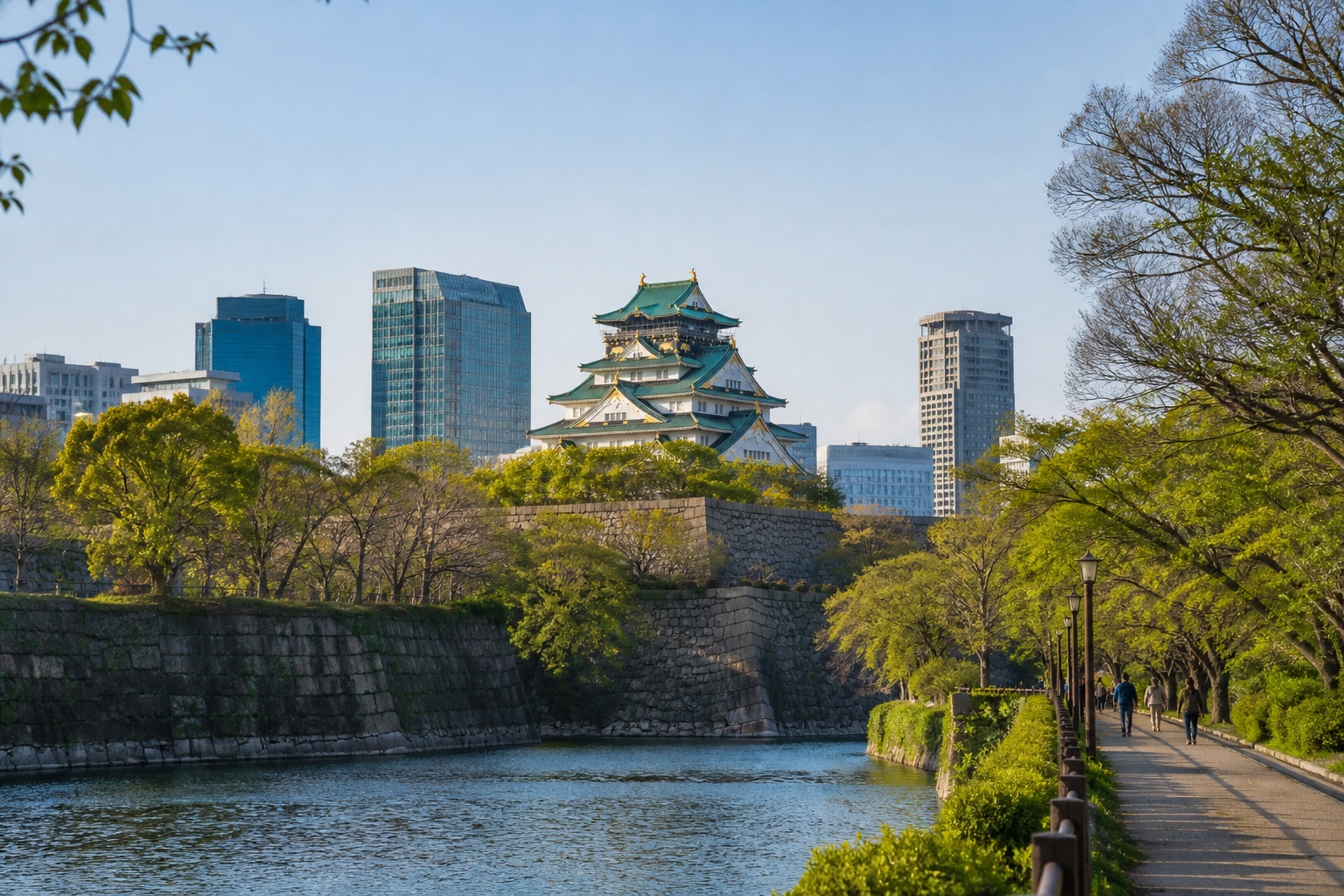
Osaka is often reduced to a food stop between Kyoto and the airport, or used as a base for so many day trips that the city itself disappears. A stronger plan gives Osaka at least one coherent city day and lets its neighborhoods carry the route. The castle, market streets, commercial center, and southern evening districts are not one compact cluster, even when the rail map makes them look easy to combine.
Divide the city into workable halves
Osaka Castle and its broad park fit naturally with the business and river areas to the north and east. Namba, Dotonbori, Kuromon Market, and the lanes around Hozenji belong to a southern route that works better later in the day. Shinsekai and Tennoji can extend that route, but adding them merely to collect another landmark can turn the afternoon into repeated station changes.
Treat food as part of the geography. Kuromon is best approached as a market visit, while a Dotonbori evening is about lights, movement, and choosing a few things rather than joining every queue. A reservation-worthy dinner may deserve its own neighborhood; casual specialties are easier to fit along the walking route. Osaka rewards appetite, but it does not require eating continuously.
Choose day trips without erasing Osaka
Kyoto, Nara, Kobe, and Himeji are all reachable, yet each consumes the useful middle of a day. Decide which excursion advances the trip rather than treating proximity as an obligation. If Osaka follows several temple-heavy Kyoto days, its markets, contemporary cityscape, aquarium, or slower neighborhood evening can provide a welcome change of pace.
The Japan Golden Route itinerary shows where Osaka can sit within a longer first trip. Use the Osaka first-timer collection to shape the city days, then plan your Osaka trip around the neighborhoods and meals you actually want.