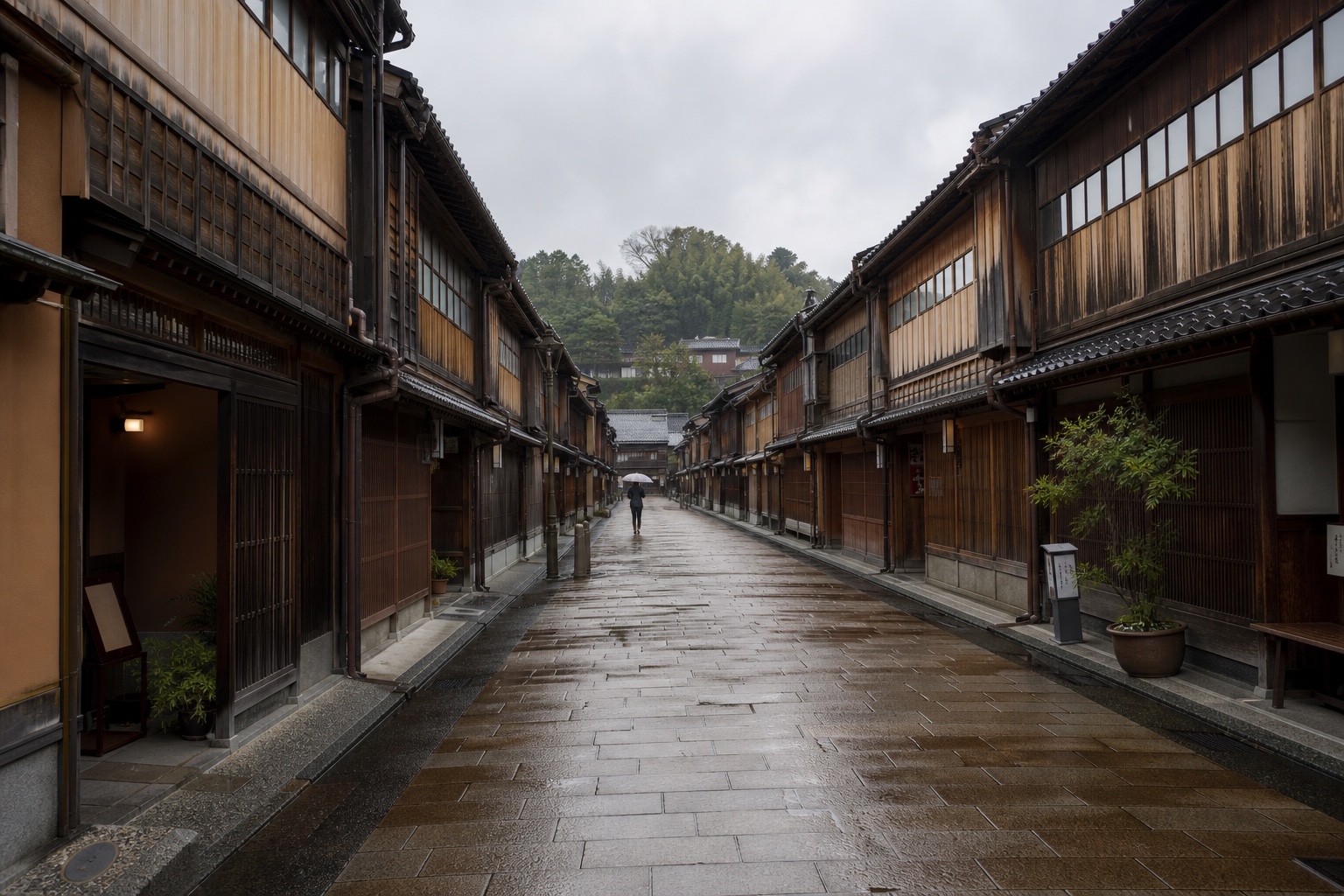
Kanazawa appears compact, but its most rewarding areas sit around the center rather than on one continuous pedestrian spine. Buses connect them, walking reveals more, and rain or snow can change the sensible order. Two full days are enough for a strong introduction; a third creates room for craft, a substantial museum, or a slower neighborhood morning.
Pair adjacent places, not category labels
Kenroku-en and Kanazawa Castle belong together geographically, with nearby museums offering a natural extension. Omicho Market works well earlier in the day before moving toward the central cultural area. Higashi Chaya lies in another direction, while the Nagamachi samurai district fits more naturally with the western side of the center. Trying to visit every preserved district in one sweep can produce more transit than atmosphere.
The city is also a place to see craft as current work, not only as decoration. Gold leaf, ceramics, lacquerware, textiles, and contemporary design can justify a workshop or focused museum visit. Check reservation requirements before building the day around a hands-on experience, and leave enough time to engage with it rather than treating it as a photo stop.
Plan for Hokuriku weather
Sea of Japan weather can be wet and changeable. A garden visit may be beautiful in rain, but the itinerary still needs a dry alternative and realistic bus time. Keep one museum, market, or craft stop movable, and avoid placing the most weather-sensitive walk immediately before a fixed train departure.
The three-day Kanazawa itinerary provides a measured city-break structure. Use the Kanazawa first-timer collection to choose priorities, then plan your Kanazawa trip around craft bookings, weather, and onward rail timing.